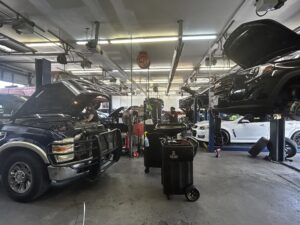
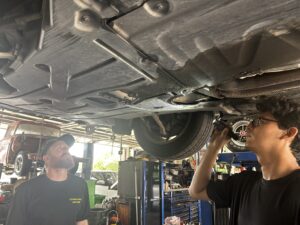
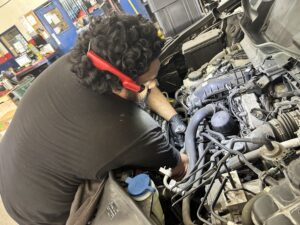
We hear this question a lot at Chimney Rock Car Care, and we completely understand where it comes from. When something goes wrong with your car, it’s natural to wonder why finding the issue costs money before any repairs even start. The truth is, a proper diagnosis isn’t just “plugging in a scanner” — it’s a step-by-step investigative process that requires advanced tools, specialized training, and time to do right.
 Step 1: Initial Scan and System Review
The process often starts with connecting a professional-grade scan tool to your vehicle’s onboard computer system. But this is only the first step — not the full diagnosis. The scanner reads Diagnostic Trouble Codes (DTCs) stored by your vehicle’s control modules (engine, transmission, ABS, etc.).
These codes don’t tell us exactly what part failed — they point us toward a system or circuit that needs testing.
Example:
A code might say “O2 Sensor Voltage Low.” That doesn’t necessarily mean the sensor itself is bad — it could be a wiring issue, a bad ground, a fuel trim problem, or even a computer update that’s needed.
 Step 2: Research and Technical Data
Once we pull the codes, our ASE-certified technicians reference manufacturer repair information, service bulletins (TSBs), wiring diagrams, and past case data. Vehicles today are built with complex electrical networks — some have more computer modules than an airplane.
Accessing the right data and knowing where to look can save hours of guesswork.
 Step 3: Testing and Verification
This is where the real diagnostic work happens. Depending on what the initial findings suggest, we may perform:
- Electrical testing using a digital multimeter or oscilloscope to check signal quality and voltage drops
- Fuel pressure or compression tests to verify mechanical health
- Smoke testing to find vacuum or EVAP leaks
- Live data monitoring while the engine runs to observe sensor activity and system responses
- Circuit tracing and component activation using advanced scan tools
Each of these tests takes precision, time, and the right equipment — all to make sure we identify the true cause of the problem rather than just treating symptoms.
 Step 4: Confirmation and Reporting
Once we isolate the fault, the technician verifies the issue through a final test or control check to ensure the diagnosis is correct. Then, we provide a detailed report outlining:
- What was tested
- What was found
- What repairs are needed and why
At this point, we can make an informed repair recommendation. Our goal is always to get it right the first time, but sometimes one issue hides another.
For example, if your radiator hose has a large cut and is leaking coolant, that leak must be repaired before we can pressure-test the rest of the cooling system. Once the major leak is sealed, a smaller leak — such as from a water pump, heater hose, or radiator seam — may become visible.
That’s why the diagnostic process can involve multiple steps: we fix what’s clearly damaged first, then retest to ensure the entire system is sound.
 Why It’s Worth Paying for a Quality Diagnostic
Paying for diagnostic time almost always saves you money in the long run. Instead of replacing parts blindly (“parts-changing”), we use a methodical approach to pinpoint the most likely root cause and address problems in a logical order.
Our goal is always to identify and fix the issue the first time, but sometimes multiple problems can overlap or mask each other. For example, an electrical short might be caused by both a corroded connector and a failing sensor — one issue can hide another until the first is repaired and retested.
This careful, step-by-step process helps ensure that each repair moves you closer to a full resolution without wasted parts or guesswork.
Our technicians invest thousands of dollars in ongoing training and tools, and our shop invests in factory-level scan equipment and software subscriptions. That’s what allows us to accurately diagnose everything from a misfire to a complex electrical issue — no matter the make or model.
 In Short
Diagnostic testing is the foundation of every proper repair. It’s not just reading a code — it’s:
- Scanning, testing, verifying, and confirming results
- Using advanced technology and expertise
- Addressing issues in logical order, especially when multiple problems exist
At Chimney Rock Car Care, we take pride in our detailed diagnostic process. We aim to get it right the first time, but when a vehicle has multiple or hidden issues, we’ll communicate clearly each step of the way so you always understand what we find and why it matters.